Showing posts with label RPG. Show all posts

Monday, September 26, 2016

Demogorgon delights

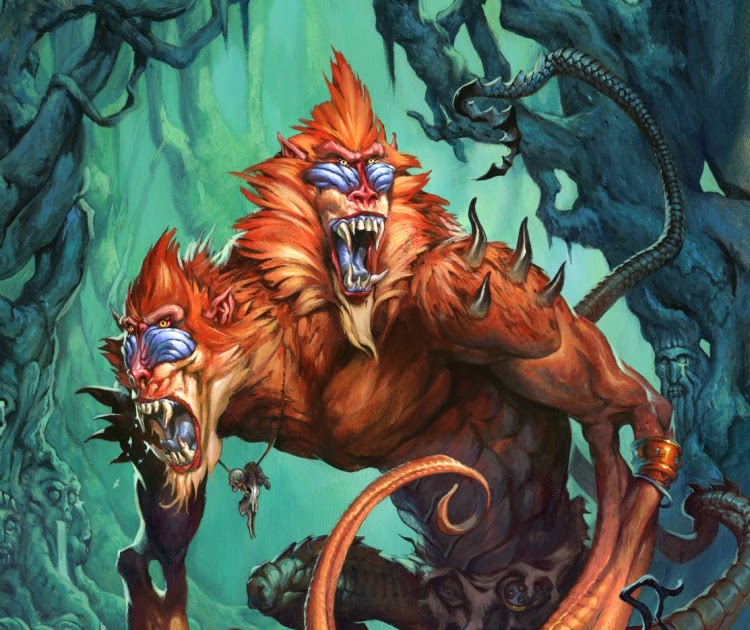
Now DnD seems to have slipped into the mainstream consciousness and my kids are interested again in adventuring in the World of Greyhawk, it's re-kindled my own grognard love of the original game. I will admit that it gave me a buzz when the lads slapped down a miniature of the 'demogorgon' on the tabletop in the introduction and entered into the discussion of defence versus assault.


Now die-hard OD&D players such as my grey-haired self would never presume that the mighty Prince of Demons would be vaguely concerned about a Fireball. After all, demons take half-damage from fire, and the Prince has 95% magic resistance, so you'd need a 20th level magic-user to have a 50/50 hope of actually sizzling him, and then he'd need to fail a save to take even half of the 20d6 damage!

I've been fascinated by Demogorgon since I first bought the Monster Manual in 1983. The characters in my various campaigns over my teen years never got close to the power level needed to trouble him (my brother Dan's characters took down Lolth in Q1, but this is a different level). And when you look at him, he really is the toughest bugger in the original MM:

200 hit points; AC -8, needing +2 weapons or better to hit (not that you'd be coming near him with anything less than a Holy Avenger); the aforementioned Demon saves and magic resistance. And whilst you're trying to chop him up as your mage sobs like a little girl in the corner, he gets some beast powers back...


He has two mandrill heads, which together use a hypnotic gaze which automatically mesmerise you if you're less than 15th level/ hit dice. The individual heads can beguile, or cause insanity. The Demogorgon's tentacles do a measly d6 damage with a rot that makes arms drop of in 6 minutes (with a quarter of the hit points), and the tail drains 1-4 levels. Ouch.

If so inclined DG can use a raft of powers, such as power word stun, telekinese, use psychic powers, levitate, polymorph, throw up a Wall of Ice. And if he doesn't fancy getting his tentacles grubby, he can Gate in his Crew: demons galore, up to type VI beasties.


Despite being a part of Greyhawk, DG and most of his demon lord friends never appeared in adventures during my time in First. Along with Orcus he was one of the original demon lords developed for the game in Eldritch Wizardry in the 70s. Their rivalry set a tone throughout the incarnations and DnD editions of the Demon Lords. Orcus, to me, was all about that artefact wand which I recall using in an early campaign.

I never played 2nd to 4th, but as I understand the Demogorgon character evolved in depth, especially when Planescape hit in the 90s (for second, I assume). The 3rd edition had a campaign focused on his machinations, specifically the opposing plots of his two heads! What a cool concept, the ultimate split-personality demon. From there he featured in some big adventures (in Dragon magazine) wherein the players could actually have a dust-off with DG in the Abyss!


My brother has recently bought 5th, and I'm considering investing myself once I've played the classic set of modules with my kids (in order, U1-3, T1-4, S2, S4, A1-4, G1-3, D1-3, Q1.... and maybe WG6 for a giggle, to take them then through the Greyhawk Wars and then maybe some of those 2nd edition Vecna/ Rary ones). I hear that there's a campaign in 5th, Out of the Abyss, where DG pops up through a rift into the Underdark below the Forgotten Realms. As it's 1st to 15th level, I assume DG is still a bad-ass, and you get to try and fight with eyes closed against him the end. So perhaps my childhood love affair with a two headed mandrill dude isn't quite finished yet....


Sunday, September 2, 2012

The Roaring Mouse Interview with Gary Vanucci

Gary was interviewed on The Roaring Mouse book blog by Ross last week. Here is the interview for the followers of SkullDust Circle.


In the endlessly running sitcom ‘Friends’ there was an episode where Joey was in Vegas and saw a croupier with the same hands as him. He dubbed him his 'hand twin.'
In a similar fashion, via the medium of Tweet I have located my author twin-Gary Vanucci.

Gary writes fantasy with an unashamedly DnD influence, focusing on detailed action and intricate world building. His Wothlandia books are set in the Realm of Ashenclaw, a land populated by adventurers, dwarves, elves, demons and dragons.Gary has developed a wealth of material to support his books- a DnD sourcebook, a great web-site, and a fantastic partnership with author-artist William Kenney. The covers are fantastic, bringing to mind the classic sixties and seventies styles that adorned sword & sorcery classics by Moorcock et al.
But a book is far more than its cover, and Gary's work doesn't fail to impress. My first exposure was one of his prequels (now collected in a single volume) and from that I went on to read Covenant of the Faceless Knights.
Covenant tells the tale of Garius, a rather dour Inquisitor, who assembles a group of disparate heroes to accompany him on a mission to rescue some priests. The heroes struggle to integrate initially - as you'd expect from a barbarian, a thief and an elf alchemist. However their journey brings out their extraordinary talents and they knit together as the story progresses. In the backstory we have a demonic warlord making alliances with succubi queens, evil dwarves and a lich. Yep, a lich! Only one down from a beholder for sheer classic DnD! The main purpose there seems to be to set up books 2+, which is something that I (as well as authors like Martin and Erikson) like to do.
The characters are great: lots of fun, interesting, with abilities verging on super powered. In fact I could pick up a big comic-book influence in Gary's style ( just like me :-D ... Truly we are author twins).
I felt genuinely curious about what happens next when the book finished, and look forward to reading the sequel. I interviewed Gary about being a self-pub author, so without further ado, over to my US 'twin.'
Me: Where did you draw the inspiration for the Wothlondia series from?

Gary: I wanted to do a series of prequel short stories that actually added not only history to my world, but character development. I am attempting to set the characters up in the mind of the reader to allow them greater depth, motivation and a sense of what makes them tick. The whole series came to me from decades of writing my own D&D adventures, campaigns, etc. Most of the story, background, maps, etc. came from those years with quite a bit of tweaks and changes to give them the feel of the Realm of Ashenclaw setting. All of the characters are my own creations. They are not old characters.

Me: You've assembled a great cast of characters. Who do you like writing the most out of them all?

I can’t choose that! It’s like asking “who is your favourite child?” I do enjoy writing them all. Orngoth to me is kind of like the Hulk. I picture this massive monster of a man and go from there. Garius is your typical leader-type with very little in the way of emotion or humor. He is slightly emotionally stunted I guess, though this is a kind of social impedance in that regard. He puts his work and his devotion above all else. Saeunn is a cold, heartless warrior with a chip on her shoulder. She has suffered great loss early on, especially if you have read Tears of Blood, and it continues in Covenant. She has become very callous and guarded emotionally, aside from her mother. Elec is a kind of young adult to me. He is very naïve and growing, kind of inexperienced and yet, extremely intelligent and full of potential. He is becoming more and more addicted to the adrenaline rush of combat as well as his elixirs. It should be a very relatable tale with him moving forward. And Rose is really developing on her own, moreso than any of the others. She started out with a rough childhood, got used to a certain lifestyle afforded her by Ganthorpe and the Thieves’ Guild and currently, she is realizing that she was missing out on the action. She has a hidden side that really enjoyed working hard and she misses the ‘thrill and excitement of her youth. And, above all else, I try to write my characters so that they seem real, with real emotion and motivations.

Me: How much has playing (and presumably DMing) role-playing games influenced your writing? Do you worry that such influences may pigeon-hole your work amongst fantasy readers?

Gary: Playing and DMing has given me more to draw on and opened my mind, as has everything else I have ever done with regards to creativity and exposing myself to other imaginary worlds. All of my past hobbies have influenced me greatly. I feel that I can place a spin on the typical good vs. bad and make it unique, fun and even engaging enough to make people want to read it. I don’t think that pigeon-holing is what I would worry about. I am telling high fantasy and a reader comes along with certain expectations in that genre, which I am fully capable of providing. However, I feel that I can place an exceptional stamp on my characters, my writing and my world that will make the experience very unique.

Me: What are your big literary influences?

Gary: R.A. Salvatore. He is amazing. I have never read an author that can put so much detail in the world, speak so uniquely, introduced so many awesome characters and still give you a fight scene that is incredibly written. I also enjoy Michael Moorcock, George Martin, Terry Brooks, Robert E. Howard, Frank Miller, Peter David, and Alan Moore. There are really too many to name. Also, I must say that there are seriously tons of good fantasy writers on the indie side that need to be read as well. Mind you, there is also a lot of garbage, which is the con about self-publishing, but there are quite a few gems out there as well. Visit Skulldust Circleand you very well may find some good ones there! *hint-hint* As a side note, I am currently reading your Darkness Rising novel and feel that I must say, your writing is brilliant and elegant, and more people really need to discover your prose as I believe they will greatly enjoy it. As a fan of epic fantasy, I would recommend it!

Me: The covers are amazing- tell us something more about them.

Gary: They developed from my mind and I give Mr. William Kenney (also another Skulldust Circleauthor and my artist!) the descriptions and he churns out something amazing for me. It is truly amazing to work with someone who shares your vision on what the quality of the covers should look like, what the characters need to look like and the overall feel and ambiance of the world I am trying to create. If you need some amazing, character-focused artwork, please look him up!

Me: Fun question: in the Hollywood blockbuster who would play your main characters?

Gary: I’ve been asked this before and still have no good answers. I’d really love Olivia Wilde to play Rose in my movie. I think she would be amazing as a smart-ass rogue-type. I think I’d like Karl Urban to play Garius. The dude is extremely intense and his scowl is unmatched. Imagine him shaved bald with a long beard…lol. The elf-like character that appeared in Hellboy 2 might make an awesome Elec. Aside from a few stars to carry the movie, I’d try to introduce some new actors in an attempt to give some fresh talent a chance to make it in the big town of Hollywood!

Me: With the advent of e-publishing, people have been predicting the end of print. I recall the same predictions with the boom of multi-player Internet based gaming that the same would happen with RPG. What are your thoughts on this?
Gary: My opinion, albeit a strong one, is: It will never happen. Never. Mark it down. There will always be a want and therefore a need for publishing houses to continue on in print. It may never be lower than it is now, but it certainly will never disappear completely. I think it would be foolish, irresponsible and short-sighted. What if something happened to the internet? All we would have left would be print.

Me: So what are your current projects?
Gary: I am currently writing Book 4 in my series, called Dance of Deceit, which continues the saga of my heroes and which I expect to be released by this Christmas…if all goes well. There will be quite a few reveals and (teaser) quite possibly a death of a character in there. (WHAT?!)

I also have a short story that will be out shortly with some of the guys from Skulldust Circle! You may have heard of them. My story is the Legend of Ashenclaw (the giant red-dragon queen whose namesake is the branding of my world!) IT should be epic for any fans of my world and there are several other amazing short stories in there that need to be perused as well. I think this cross-promotion anthology will be an awesome endeavour that introduces many readers to our work that otherwise may not have taken the chance.

Thanks for having me and I look forward to an interview with you as well!

Thanks, Gary, especially for the mention of my work!!! The Skulldust anthology will be out soon, and in the interim check out Gary’s excellent style at the links below and on his website.

Gary's Amazon page

Realm of Ashenclaw website

Covenant of the Faceless Knights

Thursday, August 23, 2012

GENCON 2012...The Experience


Here's what I was doing end of last week and beginning of this week...in case you were worried.


The bad: Surprise, surprise! The hotel and accommodations again were less than spectacular and extremely overpriced. I got slammed with a valet parking bill that was added to my bill daily for $28.00 per day. Holy crap. Lesson learned the hard way again. Oh, well.

Hey, that's my book!
hey, that's my name!

The good: Everything else!

What can I say? Awesome. That’s what.

I had an incredible time! Aside from my hotel bill…again…which I cannot seem to do anything about.

I met some amazingly interesting people that I must say were very cool. I met Jason Klimchok, (@runnetib on twitter) a fellow author who found me in Author’s Avenue and introduced himself. Very cool of him to seek me out and say hello. Mr. Erik Scott de Bie, he of the Forgotten Realms fame (game designer and author) and Shadowbane fame, made his way over to my table to chat before he went off to sign books himself in the D&D booth. I also had breakfast on Sunday with Mr. De Bie, which I will detail a bit later.

I met and introduced myself to Jeanette LeGault who runs the whole thing and who was responsible for getting me in this year. She was very kind and spared time even though she was constantly busy.

my table at GENCON 2012
Special kudos to my son, who was with me all four days (way to go, Nick!) and who endured the 10+ hour drive both up and back with me. We had a great time bonding, which I will treasure always. Nick was awesome as my ‘booth monkey’ as he so eloquently put it.

I met fellow author Chris Jackson (@ChrisAJackson1 on twitter) and his wife (Anne, I believe) and they were very nice to me as well. I sat across the way from Tammy Blackwell, a librarian and fellow author who is writing an incredibly popular coming of age series about Seers and Werewolves, which I would check out. She can be found here: http://www.amazon.com/Tammy-Blackwell/e/B005A9B3XO. Tammy was also kind enough to gift a copy of her book to my wife, who I believe will enjoy it. 

I also gave some books away to librarians, interested book bloggers and a young woman who gave me this 'token of appreciation'.

my token of appreciation
Some of the people that I met come to mind when I write this that made an impact. I met a British fella named Adam that I really enjoyed talking to. Another long-haired college kid I chatted with a few times made an impression, though I cannot remember his name. A woman named Jeanette who purchased the books was extremely nice and she came back to snap a pic of me the next day (very flattering...I think?). I met a couple who chatted with me about Pathfinder for about an hour named Blake? he and his wife are inspiring me to possibly make a Realm of Ashenclaw RPG supplement for Pathfinder... might be coming.

Here are the best two experiences. I met a man named Tony Rodriguez who wanted the books and purchased them from me on Saturday and had me sign them to his son, Alex. He happened to bring Alex in on Sunday and he was happy to meet me, told me he’d read up to chapter 6 that morning and was loving it. Wow! That made my day. And it got better. The second was a man named Scott, who had downloaded Wothlondia Rising: The Anthology (The short story prequels) to his kindle. He went out of his way to come back on Sunday morning to tell me that he was 94% through the book and thought it was amazing…and that he had downloaded the other two books that morning!

I was again completely humbled by their expressions of how I had affected two different people in such a great way. I felt honored that they had chosen me and my writing in order to escape from reality. I was honored that they both entered into my Realm of Ashenclaw with open arms and with an open mind. I cannot express in words how that makes me feel as an author and a human being.

So, on to my breakfast meeting with Erik Scott De Bie on Sunday. I must tell you that it was a tale of mishaps and odd misunderstandings as Erik and I exchanged texts as to where to meet, but after an hour, we finally caught up at a Starbucks there. Interestingly enough, Erik is a rather tall and imposing individual and carries himself very well in conversation. That being said, Erik and I talked about many things. The most memorable to me was his advice. He gave me some constructive criticisms, advice on becoming a better writer and talked to me as a peer. I cannot tell you what his respect means. He not only gave me the critique, but he also made a point to give me the good news, and I am paraphrasing, but, it included the following: My covers were eye-catching and consistent, my branding and logo (Realm of Ashenclaw) was extremely professional and most importantly, that my writing was compelling. He went out of his way to say that I was passionate about my work, that he thought I was on to something and that he was happy to see what I was able to do as an independent author.

All of this was extremely humbling to hear from an author who works for Ed Greenwood and Dungeons & Dragons. After we parted ways, I went back to my booth for the last day and Erik stopped back one more time to gift me a copy of an anthology that he had contributed on for GenCon, which was above and beyond. I highly recommend any fans of fantasy to check him out and follow his writing, as I believe he is worthy of being included in the Forgotten Realms gaggle of writers.

Go buy his stuff! Erik’s site is here if you are interested in seeing what he is up to. http://erikscottdebie.com/

Well, that about wraps up my details. Next post will include pics of all of the scenes and costumes that I was able to get! Stay tuned.

Oh, and all of my books are currently resting at 99 cents on the kindle for a post-GENCON sale! Go download 'em before I come to my senses and raise the price...lol.

Hugs and kicks,
Gary

Wednesday, August 8, 2012

A Blackrazor by any other name...

Continuing the theme of books that influenced DnD (and therefore my writing!) the next one I thought I’d tackle was Michael Moorcock’s Elric saga. A lot of Moorcock’s work in the sixties and seventies probably had a direct influence on Gygax and the other creators of the game, not least the Corum sequence and the two Hawkmoon series (The Runestaff quartet, and the Chronicles of Count Brass trilogy), but undoubtedly Elric was a key one.

Everyone who played the game in the early Eighties with me knew of Elric, although only a few of us had read it. The RPG Runequest had a particular supplement relating to Elric as I recall, and since then I think there has been a specific game around him. I got around to reading the Fantasy Masterworks collection of Elric last year, and enjoyed it. I could see why it had appealed to so many people, although I’ve never really got into Moorcock’s style (I did enjoyed Dancers at the End of Time).

Moorcock is often quoted as saying he wrote Elric as a direct opposition to the traditional fantasy works of Tolkien and RE Howard (he famously described Lord of the Rings as akin to a fantasy Winnie the Pooh). Elric, in his original inception in the nine short stories that comprised Stormbringer (re-published by Fantasy Masterworks as ‘Elric’) is a superb anti-hero. He starts the stories leading an attack upon on his own kingdom, he then proceeds to (admittedly inadvertently at times) chop up all his mates, and he becomes addicted to his magical sword, Stormbringer. Perfect for the Sixties, when people wanted their heroes rather more flawed than the idealistic Fifties!

The influence on the game is overt in a number of areas. The DnD alignment system owes a large debt to the concept of Law and Chaos that Moorcock used, although this in itself was probably evolved from Poul Anderson’s Three Hearts and Three Lions (which I’ll review next time). Moorcock took it further, and this battle between the two forces was the key plotline in the later part of the Elric saga (and continued in parts of the Eternal Champion sequence). Law and Chaos are balanced by Neutrality (the Cosmic Balance) and in his books the Eternal Champion served the Cosmic Balance. Moorcock created deities aligned to both Law and Chaos that feature in his books. It’s easy to see how the addition of good and evil created the 9 alignments in AD&D.

Stormbringer, a runeblade that is essentially a Chaos demon in sword form, was a major aspect of Elric’s saga. It was a mighty sword that could chop through anything and drank life energy to sustain Elric, in a vampyric fashion. Its sibling blade was ‘Mournblade’ which had similar powers. In the DnD game the idea of life-drinking magic swords was most obviously emulated in White Plume Mountain (S2), which to my gang was the most frequently played module next to B2: Keep on the Borderlands. I’ve still got the original pale-orange covered one at home! The sword in question was Blackrazor, one of the three personalised magic weapons in the adventure. The author of the module, Lawrence Schick, later admitted he was embarrassed by his blatant rip-off of Stormbringer (he’d thrown the module together from his favourite bits of his own scenarios). Personally I thought it was awesome, and each time we played it there was a full-on scrabble for the soul-drinking sword.

The more subtle influence of Elric on the game was the adventuring aspects of the books. Elric has a group of companions—Moonglum, Dyvim, Rackhir—with whom he adventures, fulfilling ‘missions’ and ‘quests.’ We also had a healthy collection of opposing sorcerers, and a few monsters chucked in for good measure.

There’s a criticism of Moorcock’s Elric books that the characters can be a little flat, and the dialogue a little cheesy, but I think if you read them as a fun fantasy read in instalments (as they can get a touch ‘samey’) then you’ll not go far wrong. And let’s face it we all wanted to have a character as cool as Elric... soul-drinking sword, hot-line to demons to save your arse in a fight, a goth-look that the lasses adored... perfect.

Next up... torn between Fritz Lieber and Poul Anderson....Thieves vs. Paladins...

Friday, July 6, 2012

The Periapt of Eponymous Dweomers

There’s a list in the back of the 1st edition AD&D Dungeon Master’s Guide that always proved fascinating to me as a DnD loving child. It’s tucked away on p224, Appendix N, between Conjured Animals and Encumbrance of Standard Items (not areas of the book I used frequently it must be said).

The list is of ‘Inspirational and Educational Reading’ and was written by Gary Gygax as a sort of source guide for the things that inspired him to write DnD the way he did. What interested me as a kid was that UK book stores never seemed to have half of these authrors. The main fantasy books at the time I found were Donaldson (which I skipped), Eddings, Brooks and, latterly, Hickman and Weis’s Dragonlance. Yet I dug around then and found Robert E Howard, Michael Moorcock,  Fritz Leiber, HP Lovecraft and, of course, JRR Tolkein.

Ironically, in this series of posts on books that influenced AD&D, and thus influenced me (and I suspect most of the Skull Dust Circle) in my writing, I plan to start with books that I have read recently from that mighty list. These include Jack Vance, Poul Anderson, and Roger Zelzaney. The likes of L Sprague De Camp, Fletcher Pratt and A Merritt are on my radar to read eventually.

Jack Vance’s seminal series Tales of the Dying Earth was published over a thirty year period, with the third and fourth books (Cugel’s Saga & Rhialto the Marvellous) published in the early Eighties, and thus not a direct influence on Gygax.

The first book, The Dying Earth, is essentially a collection of linked short stories about inhabitants of an earth far into the future, where magic and science have merged together, and most recorded history is long lost. It takes a while to get settled with Vance’s prose, but once you do it is simply excellent. The tales involving mages are particularly good, and the basis of the AD&D magic system (in its first incarnation) arose here. Spells are learned, but once used disappear from the mind, until refreshed after rest. The good old Prismatic Spray pops up here, along with the penchant for eponymous dweomers (Phandaal’s Gyrator; Felojun’s Second Hypnotic Spell).

The second book tells the story of Cugel the Clever, and how he falls afoul of Iucounu, the Laughing Magician. The title ‘The Eyes of the Overworld’ refer to a magical rose-tinted lens that Cugel is sent to fetch after a burglary goes awry. He is encouraged in this quest by having a clawed demon grafted into his liver. Cugel is a wonderful anti-hero: a cheat, a liar, a coward, a rogue, a thief. He feels his wit is quicker than it is, although he still cons a fair few people on his long journey back to Iucounu. In most encounters he comes off the worst, yet you can’t but help root for him. Cugel was an evident inspiration for the thief character class in the original game, and Gygax had admitted as such in interviews he gave over the years.

The characterisation in Vance's Dying Earth quartet is excellent. He creates a selection of bizarre, verbose and articulate characters whose dialogue fizzes along. There were moments when the spectre of Blackadder rose in the verbal fencing, and I chuckled at many of Cugel's witty remarks.

Vance’s work offered a number of other things to the DnD game—Ioun stones, The Robe of Eyes, Evard’s Black Tentacles—but the influence of the magic system (and the love of eponymous spells) was the greatest contribution.  I really enjoyed reading the book and would say it’s definitely worth the time, although gentler than more modern fantasy offerings.

My review of the book on Fantasy Book Reviews is here

Wednesday, May 30, 2012

Anti-heroic fantasy

I originally posted a piece on anti-heroes in fantasy fiction as a guest blog months ago on Alison DeLuca's blogsite Fresh Pot Of Tea. It caught a few views, but I thought its topic was ideally suited to Skulldust Circle and its followers, so I'm re-posting it here :-D

As you're aware my genre is fantasy. I love it; have always loved it, ever since I could read. As a kid I was captivated by the total escapism of fantasy, by the idea of magic being a reality, by the virtues of the heroic struggling against insurmountable evils. It was a passion fuelled by an adolescence dedicated to role playing games, tucked away in mates’ sheds and front rooms, for far too many hours until my complexion emulated Gollum on a bad-skin day.

So here’s a quandary. Given that many of us who read fantasy and sci-fi and all its sub-sub genres (Elfpunk anyone?) came into the genre loving tales of the great and good defeating the gibbering armies of The Dark Tm , how come the anti-hero is so pervasive in speculative fiction?

They’re everywhere! Take the most successful fantasy series of the last ten years—George RR Martin’s Song of Ice and Fire—it is replete with anti-heroes. Tyrion Lannister has to be the favourite character amongst a sea of schemers and blaggards. He’s selfish, rude, corrupt, bitter, in fact all the traits that make a great bad guy. Yet amongst his venom there are redeeming features that make us fascinated by him. By book two we love him and by the latest he’s more or less the only one (other than Arya) we care about.

Scott Lynch’s Gentleman Bastards series has Locke Lamora, a thief and a con-man as the main character. Here we have a different flavour of anti-hero. Whereas Tyrion is a nasty piece of work who occasionally displays redeeming features, Locke is actually an alright guy—he loves his friends etc.—who screws people over for a living. Like Robin Hood or the IRS. He’s a ‘hero’ who is also criminal.

And there’s so many more in fantasy that you wonder if we ever wanted true heroes. Severian in Gene Wolfe’s The Book of the New Sun (torturer…tick), Sand dan Glotka in Abercrombie’s The First Law books (yay, another torturer…tick), Thomas Covenant in Donaldson’s epic (rapist…tick), Cugel the Clever in Jack Vance’s Tales of the Dying Earth (thief, cheat, rake…tick), Raistlin in Dragonlance (black magic, betray brother…OK…tick), Fitz in Hobb’s Farseer trilogy (assassin? Hey, sure…beats looking after the horses…tick) and, of course, Elric.

Now Elric I did love as a kid. More accurately I coveted Stormbringer, the soul-drinking sword that Elric was dominated by. To a DnD player the idea of a sword that munched on opponents life energy (and therefore boosted your own) was fantastic. The weapon Black-razor in White Plume Mountain was an obvious copy and Elric even got his own RPG supplement for RuneQuest.

Elric was the first great fantasy anti-hero in my mind. Before him we had the muscle bound might of Conan, the noble Aragorn and the almost biblical Aslan. In his very first appearance we meet him on the way to slaughter his own nation. He then further fails to impress us by wining about his doom-ridden destiny, betraying people all over the place, becoming addicted to a vampire-sword and then killing all his buddies one by one. Admittedly some he kills by accident, because he gets carried away with Stormbringer; but you’d still not add him as a friend on Facebook would you?

So why do we love them? These are characters that are far darker than the tough guys of the cinema. We all admire the surly Han Solo and love the hard as nails Clint Eastwood characters. But these are characters that are morally dubious, at times nasty and at times ruthless. They are killers, torturers, thieves—the sort most of us would eschew in reality. Why do we enjoy reading about them?

I think it’s the escapism in another form and I think therefore that that is why fantasy (the ultimate asylum from our troubled world) is replete with them. These are characters whose achievements within the books seem all the more admirable, characters that surpass all the faults and the weaknesses that they have, to become victorious. They are creations who resonate with us because of their flaws, which after all we all have (though perhaps not to the extent of these characters). Why should a being in a fantasy world have to have any less hang-ups than us?

Anti-heroes act in ways that appeal to our darker instincts. They allow us to slip away from the frustration of modern life and the constraints of society and unleash a bit of spite. Far better to read about Tyrion Lannister’s Machiavellian antics or Elric hoovering up a few souls than turn around and give our annoying bosses a head-butt on the nose.

And we can see characters every bit as flawed as ourselves and revel in the redemption that many achieve and know that for even the most screwed-up and damaged that there is hope.

So long live the anti-hero and remember even Aslan probably had some darker moments that were cut from the books. I fact I distinctly remember him hanging out with the Snow Witch sharing a crack-pipe…