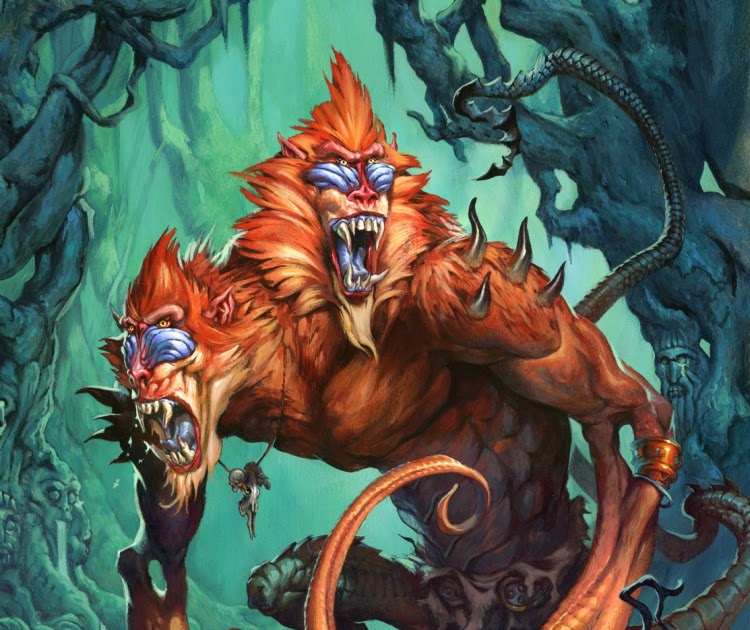
Now DnD seems to have slipped into the mainstream consciousness and my kids are interested again in adventuring in the World of Greyhawk, it's re-kindled my own grognard love of the original game. I will admit that it gave me a buzz when the lads slapped down a miniature of the 'demogorgon' on the tabletop in the introduction and entered into the discussion of defence versus assault.
Now die-hard OD&D players such as my grey-haired self would never presume that the mighty Prince of Demons would be vaguely concerned about a Fireball. After all, demons take half-damage from fire, and the Prince has 95% magic resistance, so you'd need a 20th level magic-user to have a 50/50 hope of actually sizzling him, and then he'd need to fail a save to take even half of the 20d6 damage!
I've been fascinated by Demogorgon since I first bought the Monster Manual in 1983. The characters in my various campaigns over my teen years never got close to the power level needed to trouble him (my brother Dan's characters took down Lolth in Q1, but this is a different level). And when you look at him, he really is the toughest bugger in the original MM:
200 hit points; AC -8, needing +2 weapons or better to hit (not that you'd be coming near him with anything less than a Holy Avenger); the aforementioned Demon saves and magic resistance. And whilst you're trying to chop him up as your mage sobs like a little girl in the corner, he gets some beast powers back...
He has two mandrill heads, which together use a hypnotic gaze which automatically mesmerise you if you're less than 15th level/ hit dice. The individual heads can beguile, or cause insanity. The Demogorgon's tentacles do a measly d6 damage with a rot that makes arms drop of in 6 minutes (with a quarter of the hit points), and the tail drains 1-4 levels. Ouch.
If so inclined DG can use a raft of powers, such as power word stun, telekinese, use psychic powers, levitate, polymorph, throw up a Wall of Ice. And if he doesn't fancy getting his tentacles grubby, he can Gate in his Crew: demons galore, up to type VI beasties.
Despite being a part of Greyhawk, DG and most of his demon lord friends never appeared in adventures during my time in First. Along with Orcus he was one of the original demon lords developed for the game in Eldritch Wizardry in the 70s. Their rivalry set a tone throughout the incarnations and DnD editions of the Demon Lords. Orcus, to me, was all about that artefact wand which I recall using in an early campaign.
I never played 2nd to 4th, but as I understand the Demogorgon character evolved in depth, especially when Planescape hit in the 90s (for second, I assume). The 3rd edition had a campaign focused on his machinations, specifically the opposing plots of his two heads! What a cool concept, the ultimate split-personality demon. From there he featured in some big adventures (in Dragon magazine) wherein the players could actually have a dust-off with DG in the Abyss!
My brother has recently bought 5th, and I'm considering investing myself once I've played the classic set of modules with my kids (in order, U1-3, T1-4, S2, S4, A1-4, G1-3, D1-3, Q1.... and maybe WG6 for a giggle, to take them then through the Greyhawk Wars and then maybe some of those 2nd edition Vecna/ Rary ones). I hear that there's a campaign in 5th, Out of the Abyss, where DG pops up through a rift into the Underdark below the Forgotten Realms. As it's 1st to 15th level, I assume DG is still a bad-ass, and you get to try and fight with eyes closed against him the end. So perhaps my childhood love affair with a two headed mandrill dude isn't quite finished yet....
Showing posts with label Role Playing Games. Show all posts
Monday, September 26, 2016
Sunday, September 4, 2016
Demogorgons and Debbie
It should come as no surprise to those that read my alternate monthly blog that Stranger Things was a massive hit with me. For those who haven’t seen the smash Netflix hit of the summer, it tells the tale of mid-80s rural America and four young friends, one of whom goes missing. The story unfolds as a homage to 80s sci-fi horror a la John Carpenter and Stephen King, with a dash of Spielberg BMX riding fun to glue it together.
Image from hellogiggles.com
Now apart from the obvious nostalgia value for me (with regards the music, style and every 80s film I ever loved) you’d be wondering why a Brit growing up in Northern England (just south of the Wall) in the early 80s would relate to somewhere in the US mid-west with an alcoholic sheriff called Hopper? Well the clatter of polyhedral dice and the furious debate about whether to fireball or defend against the Demogorgon should solve that mystery as quick as Scooby Doo. Dungeons and Dragons, in all its first edition glory.
(If you haven’t watched the series yet, be wary of some minor spoilers below!)
Image from ew.com
I blogged in June about my childhood love of the hobby, and the influence it had on my writing, and indeed the writing of many others. Undoubtedly it had similar influences on the Duffer brothers who wrote and directed the eight episode story. The first five minutes of episode 1 capture much of what invigorated so many with the hobby: the friendships, the excitement, the imagination. As a narrative device it works perfectly for the series. The three remaining friends use their interest in fantasy and science fiction to rationalise the increasingly bizarre events of psychic powers, parallel universes (explained brilliantly), and… monsters. The repeat reference to the monster as ‘Demogorgon’ is a real nod to the 1st Edition DnD, before concern that all fantasy gamers were Satanists purged the following editions of demons and devils. In the version played in the show, Demogorgon is the Prince of all demons, in the lowest levels of the Abyss. His two mandrill heads and tentacles made for an awesome miniature, which was slammed onto the table in that epic first minute of the show, and that reappeared as a way of explaining ‘monsters’ to El in a later episode. To the players it is the ultimate monster to be conquered, and the banter between the friends is whether against such a creature it is better to defend or attack. It is this dilemma that drives the series through to its incredible finale.
Demogorgon figure: image from bustle.com
In my childhood experience of DnD I only experienced a mild amount of teasing and mockery. Our close knit group who played, both when I lived in Leeds and later Peterborough, weren’t especially ‘outcasts’ or ‘alternative.’ Perhaps at that time, the UK was more acceptant of stranger hobbies. We all collected comics, loved sci-fi, played DnD, some had computers (ZX Spectrums, Atari, VIC 20s), most of us liked music we taped off the radio. The bullying that the three friends experience in the show is only partly related to their love of DnD, in that it gives the bullies recourse to call them names and mock their close friendships.
And of course the general perception of DnD at the time in both UK and the US wasn’t entirely rosy. Much in the way that the moral majority rallied against heavy metal music, alleging its influence on the youth of America’s moral upbringing, mental stability and suicide rates, DnD came into the righteous cross-hairs. The now infamous Jack Chick comic strip, Dark Dungeons, tells the tale of Debbie whose participation in DnD games led to her involvement in a coven mainly to get her father to buy DnD books and miniatures. The DnD provoked suicide of a friend then brought Debbie back to Christianity and redemption. The strip culminates in a good old book burning, perhaps with some Harry Potter books tossed on to help the pyre (of course I’m being facetious, as Harry Potter book burning was a product of more recent enlightened times).
The unfortunate Debbie in Dark Dungeons. Image from http://www.therobotspajamas.com/dd-kills-with-the-help-of-satan/
As amusing as it seems now, there was serious anti-DnD propaganda back in the 80s, and even the famed Tom Hanks starred in the TVM Mazes and Monsters in 1982, wherein a latent psychotic illness is unlocked by the fantasy game, Mazes and Monsters, with tragic results. The film was based mainly on the sensationalism surrounding the disappearance of a student at MSU. The80s were replete with pressure groups against DnD, in some cases driven by religious sentiments and the perception of DnD as an occult phenomenon, and in some cases bereavements and tragedy. Authors jumped on the bandwagon, associating a horrific murder with the fact the perpetrator (Chris Pritchard)was a Dungeon Master (and playing down his drug and alcohol addiction, and desire to inherit $2 million).
Yet most studies don’t indicate that players of role playing games have any higher rates of mental illness, suicide, or depression, but such studies are often ignored in the media. Did it appeal to the geekier cross-section of society? Certainly, as back then they would have been the ones with the imaginations, and the creativity to enjoy it fully. Nowadays these would be the same children and teenagers stereotyped as gamers, the same ones unfairly mocked about hunting Pokemons by a society determined to deride anyone else’s interests and fun!
Yet it is these traits, of imagination, creativity, and ultimately comradery and friendship which are the core of the heroes in Stranger Things. It’s these characteristics that lead them to accept El, and to search for their missing friend when everyone else has given up. And that’s the message in Stranger Things, and that’s one of the keys of its success—Demogorgon or no.
(As an end-note, the series has got my kids fired up about playing old school DnD again, ironically dragging them away from the aforementioned Pokemon!!).
Sunday, September 2, 2012
The Roaring Mouse Interview with Gary Vanucci
Gary was interviewed on The Roaring Mouse book blog by Ross last week. Here is the interview for the followers of SkullDust Circle.
In the endlessly running sitcom ‘Friends’ there was an episode where Joey was in Vegas and saw a croupier with the same hands as him. He dubbed him his 'hand twin.'
In a similar fashion, via the medium of Tweet I have located my author twin-Gary Vanucci.
Gary writes fantasy with an unashamedly DnD influence, focusing on detailed action and intricate world building. His Wothlandia books are set in the Realm of Ashenclaw, a land populated by adventurers, dwarves, elves, demons and dragons.Gary has developed a wealth of material to support his books- a DnD sourcebook, a great web-site, and a fantastic partnership with author-artist William Kenney. The covers are fantastic, bringing to mind the classic sixties and seventies styles that adorned sword & sorcery classics by Moorcock et al.
Gary : I wanted to do a series of prequel short stories that actually added not only history to my world, but character development. I am attempting to set the characters up in the mind of the reader to allow them greater depth, motivation and a sense of what makes them tick. The whole series came to me from decades of writing my own D&D adventures, campaigns, etc. Most of the story, background, maps, etc. came from those years with quite a bit of tweaks and changes to give them the feel of the Realm of Ashenclaw setting. All of the characters are my own creations. They are not old characters.
Me: You've assembled a great cast of characters. Who do you like writing the most out of them all?
I can’t choose that! It’s like asking “who is your favourite child?” I do enjoy writing them all. Orngoth to me is kind of like the Hulk. I picture this massive monster of a man and go from there. Garius is your typical leader-type with very little in the way of emotion or humor. He is slightly emotionally stunted I guess, though this is a kind of social impedance in that regard. He puts his work and his devotion above all else. Saeunn is a cold, heartless warrior with a chip on her shoulder. She has suffered great loss early on, especially if you have read Tears of Blood, and it continues in Covenant. She has become very callous and guarded emotionally, aside from her mother. Elec is a kind of young adult to me. He is very naïve and growing, kind of inexperienced and yet, extremely intelligent and full of potential. He is becoming more and more addicted to the adrenaline rush of combat as well as his elixirs. It should be a very relatable tale with him moving forward. And Rose is really developing on her own, moreso than any of the others. She started out with a rough childhood, got used to a certain lifestyle afforded her by Ganthorpe and the Thieves’ Guild and currently, she is realizing that she was missing out on the action. She has a hidden side that really enjoyed working hard and she misses the ‘thrill and excitement of her youth. And, above all else, I try to write my characters so that they seem real, with real emotion and motivations.
Me: How much has playing (and presumably DMing) role-playing games influenced your writing? Do you worry that such influences may pigeon-hole your work amongst fantasy readers?
Gary: Playing and DMing has given me more to draw on and opened my mind, as has everything else I have ever done with regards to creativity and exposing myself to other imaginary worlds. All of my past hobbies have influenced me greatly. I feel that I can place a spin on the typical good vs. bad and make it unique, fun and even engaging enough to make people want to read it. I don’t think that pigeon-holing is what I would worry about. I am telling high fantasy and a reader comes along with certain expectations in that genre, which I am fully capable of providing. However, I feel that I can place an exceptional stamp on my characters, my writing and my world that will make the experience very unique.
Me: What are your big literary influences?
Gary : R.A. Salvatore. He is amazing. I have never read an author that can put so much detail in the world, speak so uniquely, introduced so many awesome characters and still give you a fight scene that is incredibly written. I also enjoy Michael Moorcock, George Martin, Terry Brooks, Robert E. Howard, Frank Miller, Peter David, and Alan Moore. There are really too many to name. Also, I must say that there are seriously tons of good fantasy writers on the indie side that need to be read as well. Mind you, there is also a lot of garbage, which is the con about self-publishing, but there are quite a few gems out there as well. Visit Skulldust Circle and you very well may find some good ones there! *hint-hint* As a side note, I am currently reading your Darkness Rising novel and feel that I must say, your writing is brilliant and elegant, and more people really need to discover your prose as I believe they will greatly enjoy it. As a fan of epic fantasy, I would recommend it!
Me: The covers are amazing- tell us something more about them.
Gary : They developed from my mind and I give Mr. William Kenney (also another Skulldust Circle author and my artist!) the descriptions and he churns out something amazing for me. It is truly amazing to work with someone who shares your vision on what the quality of the covers should look like, what the characters need to look like and the overall feel and ambiance of the world I am trying to create. If you need some amazing, character-focused artwork, please look him up!
Me: Fun question: in theHollywood blockbuster who would play your main characters?
Gary : I’ve been asked this before and still have no good answers. I’d really love Olivia Wilde to play Rose in my movie. I think she would be amazing as a smart-ass rogue-type. I think I’d like Karl Urban to play Garius. The dude is extremely intense and his scowl is unmatched. Imagine him shaved bald with a long beard…lol. The elf-like character that appeared in Hellboy 2 might make an awesome Elec. Aside from a few stars to carry the movie, I’d try to introduce some new actors in an attempt to give some fresh talent a chance to make it in the big town of Hollywood !
Me: With the advent of e-publishing, people have been predicting the end of print. I recall the same predictions with the boom of multi-player Internet based gaming that the same would happen with RPG. What are your thoughts on this?
Gary : My opinion, albeit a strong one, is: It will never happen. Never. Mark it down. There will always be a want and therefore a need for publishing houses to continue on in print. It may never be lower than it is now, but it certainly will never disappear completely. I think it would be foolish, irresponsible and short-sighted. What if something happened to the internet? All we would have left would be print.
Me: So what are your current projects?
Gary : I am currently writing Book 4 in my series, called Dance of Deceit, which continues the saga of my heroes and which I expect to be released by this Christmas…if all goes well. There will be quite a few reveals and (teaser) quite possibly a death of a character in there. (WHAT?!)
I also have a short story that will be out shortly with some of the guys fromSkulldust Circle ! You may have heard of them. My story is the Legend of Ashenclaw (the giant red-dragon queen whose namesake is the branding of my world!) IT should be epic for any fans of my world and there are several other amazing short stories in there that need to be perused as well. I think this cross-promotion anthology will be an awesome endeavour that introduces many readers to our work that otherwise may not have taken the chance.
Thanks for having me and I look forward to an interview with you as well!
Thanks,Gary , especially for the mention of my work!!! The Skulldust anthology will be out soon, and in the interim check out Gary ’s excellent style at the links below and on his website.
Gary's Amazon page
Realm of Ashenclaw website
Covenant of the Faceless Knights
In the endlessly running sitcom ‘Friends’ there was an episode where Joey was in Vegas and saw a croupier with the same hands as him. He dubbed him his 'hand twin.'
In a similar fashion, via the medium of Tweet I have located my author twin-Gary Vanucci.
But a book is far more than its cover, and Gary 's work doesn't fail to impress. My first exposure was one of his prequels (now collected in a single volume) and from that I went on to read Covenant of the Faceless Knights.
Covenant tells the tale of Garius, a rather dour Inquisitor, who assembles a group of disparate heroes to accompany him on a mission to rescue some priests. The heroes struggle to integrate initially - as you'd expect from a barbarian, a thief and an elf alchemist. However their journey brings out their extraordinary talents and they knit together as the story progresses. In the backstory we have a demonic warlord making alliances with succubi queens, evil dwarves and a lich. Yep, a lich! Only one down from a beholder for sheer classic DnD! The main purpose there seems to be to set up books 2+, which is something that I (as well as authors like Martin and Erikson) like to do.
The characters are great: lots of fun, interesting, with abilities verging on super powered. In fact I could pick up a big comic-book influence in Gary 's style ( just like me :-D ... Truly we are author twins).
I felt genuinely curious about what happens next when the book finished, and look forward to reading the sequel. I interviewed Gary about being a self-pub author, so without further ado, over to my US 'twin.'
Me: Where did you draw the inspiration for the Wothlondia series from?
Me: You've assembled a great cast of characters. Who do you like writing the most out of them all?
I can’t choose that! It’s like asking “who is your favourite child?” I do enjoy writing them all. Orngoth to me is kind of like the Hulk. I picture this massive monster of a man and go from there. Garius is your typical leader-type with very little in the way of emotion or humor. He is slightly emotionally stunted I guess, though this is a kind of social impedance in that regard. He puts his work and his devotion above all else. Saeunn is a cold, heartless warrior with a chip on her shoulder. She has suffered great loss early on, especially if you have read Tears of Blood, and it continues in Covenant. She has become very callous and guarded emotionally, aside from her mother. Elec is a kind of young adult to me. He is very naïve and growing, kind of inexperienced and yet, extremely intelligent and full of potential. He is becoming more and more addicted to the adrenaline rush of combat as well as his elixirs. It should be a very relatable tale with him moving forward. And Rose is really developing on her own, moreso than any of the others. She started out with a rough childhood, got used to a certain lifestyle afforded her by Ganthorpe and the Thieves’ Guild and currently, she is realizing that she was missing out on the action. She has a hidden side that really enjoyed working hard and she misses the ‘thrill and excitement of her youth. And, above all else, I try to write my characters so that they seem real, with real emotion and motivations.
Me: How much has playing (and presumably DMing) role-playing games influenced your writing? Do you worry that such influences may pigeon-hole your work amongst fantasy readers?
Gary: Playing and DMing has given me more to draw on and opened my mind, as has everything else I have ever done with regards to creativity and exposing myself to other imaginary worlds. All of my past hobbies have influenced me greatly. I feel that I can place a spin on the typical good vs. bad and make it unique, fun and even engaging enough to make people want to read it. I don’t think that pigeon-holing is what I would worry about. I am telling high fantasy and a reader comes along with certain expectations in that genre, which I am fully capable of providing. However, I feel that I can place an exceptional stamp on my characters, my writing and my world that will make the experience very unique.
Me: What are your big literary influences?
Me: The covers are amazing- tell us something more about them.
Me: Fun question: in the
Me: With the advent of e-publishing, people have been predicting the end of print. I recall the same predictions with the boom of multi-player Internet based gaming that the same would happen with RPG. What are your thoughts on this?
Me: So what are your current projects?
I also have a short story that will be out shortly with some of the guys from
Thanks for having me and I look forward to an interview with you as well!
Thanks,
Gary's Amazon page
Wednesday, August 8, 2012
A Blackrazor by any other name...
Continuing the theme of books that influenced DnD (and therefore my writing!) the next
one I thought I’d tackle was Michael Moorcock’s Elric saga. A lot of Moorcock’s
work in the sixties and seventies probably had a direct influence on Gygax and
the other creators of the game, not least the Corum sequence and the two
Hawkmoon series (The Runestaff quartet, and the Chronicles of Count Brass
trilogy), but undoubtedly Elric was a key one.
Everyone who played the game in the early Eighties with me
knew of Elric, although only a few of us had read it. The RPG Runequest had a
particular supplement relating to Elric as I recall, and since then I think
there has been a specific game around him. I got around to reading the Fantasy
Masterworks collection of Elric last year, and enjoyed it. I could see why it
had appealed to so many people, although I’ve never really got into Moorcock’s
style (I did enjoyed Dancers at the
End of Time).
Moorcock is often quoted as saying he wrote Elric as a direct opposition to the traditional fantasy works of Tolkien and RE Howard (he famously described Lord of the Rings as akin to a fantasy Winnie the Pooh). Elric, in his original inception in the nine short stories that comprised Stormbringer (re-published by Fantasy Masterworks as ‘Elric’) is a superb anti-hero. He starts the stories leading an attack upon on his own kingdom, he then proceeds to (admittedly inadvertently at times) chop up all his mates, and he becomes addicted to his magical sword, Stormbringer. Perfect for the Sixties, when people wanted their heroes rather more flawed than the idealistic Fifties!
The influence on the game is overt in a number of areas. The
DnD alignment system owes a large debt to the concept of Law and Chaos that
Moorcock used, although this in itself was probably evolved from Poul
Anderson’s Three Hearts and Three Lions (which I’ll review next time). Moorcock
took it further, and this battle between the two forces was the key plotline in
the later part of the Elric saga (and continued in parts of the Eternal
Champion sequence). Law and Chaos are balanced by Neutrality (the Cosmic
Balance) and in his books the Eternal Champion served the Cosmic Balance.
Moorcock created deities aligned to both Law and Chaos that feature in his
books. It’s easy to see how the addition of good and evil created the 9
alignments in AD&D.
Stormbringer, a runeblade that is essentially a Chaos demon
in sword form, was a major aspect of Elric’s saga. It was a mighty sword that
could chop through anything and drank life energy to sustain Elric, in a
vampyric fashion. Its sibling blade was ‘Mournblade’ which had similar powers.
In the DnD game the idea of life-drinking magic swords was most obviously
emulated in White Plume Mountain (S2), which to my gang was the most frequently
played module next to B2: Keep on the Borderlands. I’ve still got the original
pale-orange covered one at home! The sword in question was Blackrazor, one of
the three personalised magic weapons in the adventure. The author of the
module, Lawrence Schick, later admitted he was embarrassed by his blatant
rip-off of Stormbringer (he’d thrown the module together from his favourite
bits of his own scenarios). Personally I thought it was awesome, and each time
we played it there was a full-on scrabble for the soul-drinking sword.
The more subtle influence of Elric on the game was the
adventuring aspects of the books. Elric has a group of companions—Moonglum,
Dyvim, Rackhir—with whom he adventures, fulfilling ‘missions’ and ‘quests.’ We also
had a healthy collection of opposing sorcerers, and a few monsters chucked in
for good measure.
There’s a criticism of Moorcock’s Elric books that the characters can be a little flat, and the dialogue a little cheesy, but I think if you read them as a fun fantasy read in instalments (as they can get a touch ‘samey’) then you’ll not go far wrong. And let’s face it we all wanted to have a character as cool as Elric... soul-drinking sword, hot-line to demons to save your arse in a fight, a goth-look that the lasses adored... perfect.
Everyone who played the game in the early Eighties with me
knew of Elric, although only a few of us had read it. The RPG Runequest had a
particular supplement relating to Elric as I recall, and since then I think
there has been a specific game around him. I got around to reading the Fantasy
Masterworks collection of Elric last year, and enjoyed it. I could see why it
had appealed to so many people, although I’ve never really got into Moorcock’s
style (I did enjoyed Dancers at the
End of Time).Moorcock is often quoted as saying he wrote Elric as a direct opposition to the traditional fantasy works of Tolkien and RE Howard (he famously described Lord of the Rings as akin to a fantasy Winnie the Pooh). Elric, in his original inception in the nine short stories that comprised Stormbringer (re-published by Fantasy Masterworks as ‘Elric’) is a superb anti-hero. He starts the stories leading an attack upon on his own kingdom, he then proceeds to (admittedly inadvertently at times) chop up all his mates, and he becomes addicted to his magical sword, Stormbringer. Perfect for the Sixties, when people wanted their heroes rather more flawed than the idealistic Fifties!
The influence on the game is overt in a number of areas. The
DnD alignment system owes a large debt to the concept of Law and Chaos that
Moorcock used, although this in itself was probably evolved from Poul
Anderson’s Three Hearts and Three Lions (which I’ll review next time). Moorcock
took it further, and this battle between the two forces was the key plotline in
the later part of the Elric saga (and continued in parts of the Eternal
Champion sequence). Law and Chaos are balanced by Neutrality (the Cosmic
Balance) and in his books the Eternal Champion served the Cosmic Balance.
Moorcock created deities aligned to both Law and Chaos that feature in his
books. It’s easy to see how the addition of good and evil created the 9
alignments in AD&D.
Stormbringer, a runeblade that is essentially a Chaos demon
in sword form, was a major aspect of Elric’s saga. It was a mighty sword that
could chop through anything and drank life energy to sustain Elric, in a
vampyric fashion. Its sibling blade was ‘Mournblade’ which had similar powers.
In the DnD game the idea of life-drinking magic swords was most obviously
emulated in White Plume Mountain (S2), which to my gang was the most frequently
played module next to B2: Keep on the Borderlands. I’ve still got the original
pale-orange covered one at home! The sword in question was Blackrazor, one of
the three personalised magic weapons in the adventure. The author of the
module, Lawrence Schick, later admitted he was embarrassed by his blatant
rip-off of Stormbringer (he’d thrown the module together from his favourite
bits of his own scenarios). Personally I thought it was awesome, and each time
we played it there was a full-on scrabble for the soul-drinking sword.
The more subtle influence of Elric on the game was the
adventuring aspects of the books. Elric has a group of companions—Moonglum,
Dyvim, Rackhir—with whom he adventures, fulfilling ‘missions’ and ‘quests.’ We also
had a healthy collection of opposing sorcerers, and a few monsters chucked in
for good measure.There’s a criticism of Moorcock’s Elric books that the characters can be a little flat, and the dialogue a little cheesy, but I think if you read them as a fun fantasy read in instalments (as they can get a touch ‘samey’) then you’ll not go far wrong. And let’s face it we all wanted to have a character as cool as Elric... soul-drinking sword, hot-line to demons to save your arse in a fight, a goth-look that the lasses adored... perfect.
Next up... torn between Fritz Lieber and Poul
Anderson....Thieves vs. Paladins...
Wednesday, July 11, 2012
Wothlondia Rising Anthology 99 Cent Sale in July!
As of today I have pulled all of my 99 cent single short stories in the WOTHLONDIA RISING series that I had released since January of this year. In their place is the Anthology, now on Amazon kindle AND in Paperback, which includes ALL 5 of the short stories (Distant Familiarity, A Rose in Bloom, Maturation Process, Tears of Blood, Strength of Faith) and includes a never-before-released story about the half-ogre barbarian, Orngoth, called Reflections.
As an added bonus, the prologue to Covenant of the Faceless Knights follows the story entitled Distant Familiarity which details the events just prior to Covenant. So, as you can see, this is a worthy addition to the Realm of Ashenclaw series and I have given it the name: Beginnings Book 0. It adds depth, history, character and gives you a glance into events that placed these heroes on the path they now walk. If you enjoyed Covenant (and even Secrets of the Ebonite Mines, which is also available), I would recommend you stepping into the past of these exciting characters and learn a bit about what makes them tick!
As an incentive, I have reduced the cost from $2.99 down to .99 cents until the end of July! I hope you take the time to check it out and look forward to any and all reviews you might give.
![]() |
| Cover to the CreateSpace Paperback |
As an incentive, I have reduced the cost from $2.99 down to .99 cents until the end of July! I hope you take the time to check it out and look forward to any and all reviews you might give.
Friday, July 6, 2012
The Periapt of Eponymous Dweomers
There’s a list in the back of the 1st edition
AD&D Dungeon Master’s Guide that always proved fascinating to me as a DnD
loving child. It’s tucked away on p224, Appendix N, between Conjured Animals
and Encumbrance of Standard Items (not areas of the book I used frequently it
must be said).The list is of ‘Inspirational and Educational Reading’ and was written by Gary Gygax as a sort of source guide for the things that inspired him to write DnD the way he did. What interested me as a kid was that UK book stores never seemed to have half of these authrors. The main fantasy books at the time I found were Donaldson (which I skipped), Eddings, Brooks and, latterly, Hickman and Weis’s Dragonlance. Yet I dug around then and found Robert E Howard, Michael Moorcock, Fritz Leiber, HP Lovecraft and, of course, JRR Tolkein.
Ironically, in this series of posts on books that influenced
AD&D, and thus influenced me (and I suspect most of the Skull Dust Circle)
in my writing, I plan to start with books that I have read recently from that
mighty list. These include Jack Vance, Poul Anderson, and Roger Zelzaney. The
likes of L Sprague De Camp, Fletcher Pratt and A Merritt are on my radar to
read eventually.Jack Vance’s seminal series Tales of the Dying Earth was published over a thirty year period, with the third and fourth books (Cugel’s Saga & Rhialto the Marvellous) published in the early Eighties, and thus not a direct influence on Gygax.
The first book, The Dying Earth, is essentially a collection
of linked short stories about inhabitants of an earth far into the future,
where magic and science have merged together, and most recorded history is long
lost. It takes a while to get settled with Vance’s prose, but once you do it is
simply excellent. The tales involving mages are particularly good, and the
basis of the AD&D magic system (in its first incarnation) arose here.
Spells are learned, but once used disappear from the mind, until refreshed
after rest. The good old Prismatic Spray pops up here, along with the penchant
for eponymous dweomers (Phandaal’s Gyrator; Felojun’s Second Hypnotic Spell).The second book tells the story of Cugel the Clever, and how he falls afoul of Iucounu, the Laughing Magician. The title ‘The Eyes of the Overworld’ refer to a magical rose-tinted lens that Cugel is sent to fetch after a burglary goes awry. He is encouraged in this quest by having a clawed demon grafted into his liver. Cugel is a wonderful anti-hero: a cheat, a liar, a coward, a rogue, a thief. He feels his wit is quicker than it is, although he still cons a fair few people on his long journey back to Iucounu. In most encounters he comes off the worst, yet you can’t but help root for him. Cugel was an evident inspiration for the thief character class in the original game, and Gygax had admitted as such in interviews he gave over the years.
The characterisation in Vance's Dying Earth quartet is excellent. He creates a selection of bizarre, verbose and articulate characters whose dialogue fizzes along. There were moments when the spectre of Blackadder rose in the verbal fencing, and I chuckled at many of Cugel's witty remarks.Vance’s work offered a number of other things to the DnD game—Ioun stones, The Robe of Eyes, Evard’s Black Tentacles—but the influence of the magic system (and the love of eponymous spells) was the greatest contribution. I really enjoyed reading the book and would say it’s definitely worth the time, although gentler than more modern fantasy offerings.
My review of the book on Fantasy Book Reviews is here
Thursday, June 14, 2012
The Tome of Inspiration +5
I blogged recently (on my random mescaline-addled blogspot) about inspirations that have guided my writing--and within that is not just my published fantasy work, but my YA sci-fi story currently lurking in a slush-pile somewhere nowhere near you. The blog noted the key influence of comics in my style, focusing particularly on the work of John Byrne.
But if I had to cite one key formative step in my writing there is no doubt that it would be role playing games, and of them all (and believe me I played almost all of them in the Eighties) it has to be Dungeons and Dragons.
This will come as no surprise to those who read Skulldust Circle, and indeed I know that at least one (if not most) of my six buddies owe allegiance to the frothing offspring of E Gary Gygax. This is the "I'm Spartacus" moment when they all concur....
[Echoes of fervent agreement as I level my Crossbow of Author Castrating +2]
I first observed the DnD phenomenon via my mate Nick Earnshaw's brothers' piles of DnD stuff. They were placed around his house, in little piles, under tables and cabinets- enticing mounds of graph paper, funny dice, rule books and modules. This was in c1981 and thus we are talking old school first edition AD&D here. I properly got into it when (a) I started on the Fighting Fantasy books and (b) got intrigued by The Hobbit and Lord of the Rings. Ralph Bakshi had released a cartoon of LOTR and i recall seeing a recovered LOTR book at my mate's house (and indeed, we later played Middle Earth RPG). I started, as many did, on Basic D&D, moving onto Expert and from that, Advanced. I spent my life savings (about £30) on the Dungeon Masters Guide and the Players Handbook, doing without the Monster Manual for year or so (creating many odd interpretations of the monsters found in that big table in the appendix of the DMG).
And the creativity began. We played a lot of the modules at first: The giant and the Drow ones (G1-3, D1-3, Q1) I ran with my younger brother. We played White Plume Mountain about ten times over (how cool was Black Razor? Like bloody StormBringer), Tomb of Horrors, one of the A ones (I forget which) and... as time went on, and the adventures got cooler, the UK modules and Dragonlance (and of course, Ravenloft).
But the real fun in the game was the real creativity--the writing of my own adventures, the generation of a campaign. Although through the Eighties we played dozens of other RPGs (Runequest, Traveller, Star Frontiers, Gamma World, Call of Cthulhu, Paranoia, Dr Who, Star Trek, MERPG, Toon, Judge Dredd, Bushido, Marvel Superheroes, Villians and Vigilantes, the time travel one, a gangster one too....) DnD was always my favourite. What we created changed with our tastes, or maturity and our outside influences. In the beginning it was daft, far-fetched, almost cartoonish--i recall a repeat-action crossbow that we loved in Hawk The Slayer, that half the characters had. Later we would weave together intricate campaigns, with fully realised histories.
I was never one for using TSRs campaign worlds (Greyhawk, Forgotten Realms) although when I ran a campaign in 1988-1991 i used the Fighting Fantasy sourcebook Titan as the basis for the adventures. But the story became personal, almost like a soap opera, with marriages, kids, relationships. old family feuds, arch-enemies and recurrent villains. Like a story, like a RPG should be.
Then I hit medical school, and we all moved apart in the country. Bar one or two sessions we all accepted that we'd not play again and, when wives and kids arrived, it seemed even less likely.
Around 5 years ago, bored one evening, i began to write a quick story about the characters we used to play with. I e-mailed it out to the guys and they loved it, and so I began to write a story as if we were playing the adventures again, with all the references to the characters histories.
It felt great, creating once more, breathing life into dialogue and action. The 300 pages the story ran to taught me a huge amount about writing, about structure. As it was concluding one of my mates, Ant, commented that I should tackle something brand new... something not related to our prior campaign.
So it began with a map... and now its a six book saga.
It took a while to escape the complete DnD influence. The first draft was very DnD style, with the magic derivative, and the characters almost having classes and levels! It took a bit of discipline and merciless use of the Red Pen of Sorrow +1 to tame the bias in the text.
But despite the modifications and moderations, it is unashamedly a book written by a DnD player (and Dungeon Master). I'm proud of that fact, and proud that I'm now starting a campaign with my kids (aged 10 and 8)... and White Plume Mountain awaits....
Over my next few posts I thought I'd bring it full circle. When I began playing DnD it inspired my reading of fantasy. The books I read then had a huge impact on me and I've continued my love of the fantasy classics that shaped the DnD games recently with a few books that I always meant to read. For fun I'm going to talk about them as i read them over the next six or so SkullDust posts I'm writing. Hope it'll be interesting fro gamers and fantasy buffs alike.
But if I had to cite one key formative step in my writing there is no doubt that it would be role playing games, and of them all (and believe me I played almost all of them in the Eighties) it has to be Dungeons and Dragons.This will come as no surprise to those who read Skulldust Circle, and indeed I know that at least one (if not most) of my six buddies owe allegiance to the frothing offspring of E Gary Gygax. This is the "I'm Spartacus" moment when they all concur....
[Echoes of fervent agreement as I level my Crossbow of Author Castrating +2]
I first observed the DnD phenomenon via my mate Nick Earnshaw's brothers' piles of DnD stuff. They were placed around his house, in little piles, under tables and cabinets- enticing mounds of graph paper, funny dice, rule books and modules. This was in c1981 and thus we are talking old school first edition AD&D here. I properly got into it when (a) I started on the Fighting Fantasy books and (b) got intrigued by The Hobbit and Lord of the Rings. Ralph Bakshi had released a cartoon of LOTR and i recall seeing a recovered LOTR book at my mate's house (and indeed, we later played Middle Earth RPG). I started, as many did, on Basic D&D, moving onto Expert and from that, Advanced. I spent my life savings (about £30) on the Dungeon Masters Guide and the Players Handbook, doing without the Monster Manual for year or so (creating many odd interpretations of the monsters found in that big table in the appendix of the DMG).
And the creativity began. We played a lot of the modules at first: The giant and the Drow ones (G1-3, D1-3, Q1) I ran with my younger brother. We played White Plume Mountain about ten times over (how cool was Black Razor? Like bloody StormBringer), Tomb of Horrors, one of the A ones (I forget which) and... as time went on, and the adventures got cooler, the UK modules and Dragonlance (and of course, Ravenloft).
But the real fun in the game was the real creativity--the writing of my own adventures, the generation of a campaign. Although through the Eighties we played dozens of other RPGs (Runequest, Traveller, Star Frontiers, Gamma World, Call of Cthulhu, Paranoia, Dr Who, Star Trek, MERPG, Toon, Judge Dredd, Bushido, Marvel Superheroes, Villians and Vigilantes, the time travel one, a gangster one too....) DnD was always my favourite. What we created changed with our tastes, or maturity and our outside influences. In the beginning it was daft, far-fetched, almost cartoonish--i recall a repeat-action crossbow that we loved in Hawk The Slayer, that half the characters had. Later we would weave together intricate campaigns, with fully realised histories.I was never one for using TSRs campaign worlds (Greyhawk, Forgotten Realms) although when I ran a campaign in 1988-1991 i used the Fighting Fantasy sourcebook Titan as the basis for the adventures. But the story became personal, almost like a soap opera, with marriages, kids, relationships. old family feuds, arch-enemies and recurrent villains. Like a story, like a RPG should be.
Then I hit medical school, and we all moved apart in the country. Bar one or two sessions we all accepted that we'd not play again and, when wives and kids arrived, it seemed even less likely.
Around 5 years ago, bored one evening, i began to write a quick story about the characters we used to play with. I e-mailed it out to the guys and they loved it, and so I began to write a story as if we were playing the adventures again, with all the references to the characters histories.
It felt great, creating once more, breathing life into dialogue and action. The 300 pages the story ran to taught me a huge amount about writing, about structure. As it was concluding one of my mates, Ant, commented that I should tackle something brand new... something not related to our prior campaign.
So it began with a map... and now its a six book saga.
It took a while to escape the complete DnD influence. The first draft was very DnD style, with the magic derivative, and the characters almost having classes and levels! It took a bit of discipline and merciless use of the Red Pen of Sorrow +1 to tame the bias in the text.
But despite the modifications and moderations, it is unashamedly a book written by a DnD player (and Dungeon Master). I'm proud of that fact, and proud that I'm now starting a campaign with my kids (aged 10 and 8)... and White Plume Mountain awaits....
Over my next few posts I thought I'd bring it full circle. When I began playing DnD it inspired my reading of fantasy. The books I read then had a huge impact on me and I've continued my love of the fantasy classics that shaped the DnD games recently with a few books that I always meant to read. For fun I'm going to talk about them as i read them over the next six or so SkullDust posts I'm writing. Hope it'll be interesting fro gamers and fantasy buffs alike.
Subscribe to:
Posts (Atom)